
The Da Vinci Code
רבי אבהו אמר: מקום שבעלי תשובה עומדים – צדיקים גמורים אינם יכולים לעמוד בו
When people get older, the emotional connections to servants could become stronger than emotional connections to children; the old people become infantile and often forget if they have any children.
770 Eastern Parkway - בית חיינו
770 was a former abortion clinic. Suddenly it was no longer a curiosity but felt ominous. A friend has a house overlooking a Catholic cemetery; he said it’s bad feng shui. But I don’t know if feng shui is real. Maybe it is real if you believe in it? Let’s ask the AI about 770. But before AI, I already published this NYT article on the old mentalblog. It was a tip from a reader.
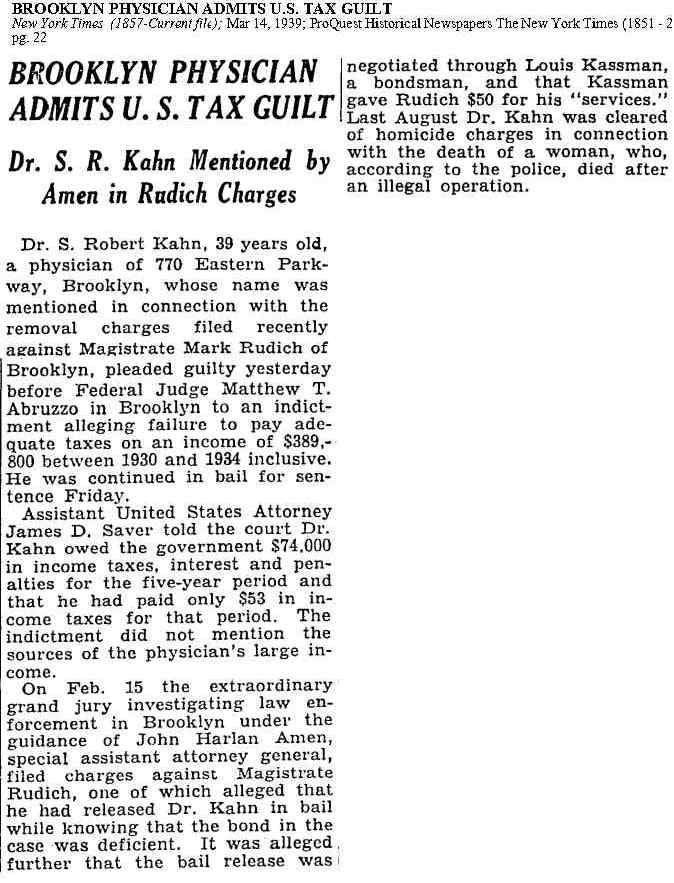
The good doctor made $389,800 in 4 years (1930-1934) during the Great Depression deflation period! For $50 you could buy a magistrate of court then and still have some money left over for a flunky lawyer, Louis Kassman, who bribed the magistrate. Dr. Kahn's income in four years during the Great Depression, converted to today’s dollars, equals $8,840,000!
The cost of abortion in 1934, according to Grok:
More established urban practitioners or clinics often charged $50–$125, sometimes on a sliding scale based on gestational age (higher for later procedures).
High-end or discreet services for wealthier patients could reach $200–$300 or more.
$389,800 in four years—did Dr. Kahn run an “abortion mill”? Let's take the high-end of the abortion cost, $300 ($7,200 per abortion in today’s dollars; the doctor likely charged even more; see below). That’s 1,300 abortions in 4 years, or 325 abortions per year; it’s eminently doable. It's unpleasant to think about what this building was designed for. OK, let’s not jump to the unpleasant conclusions. Let’s pretend it’s a regular doctor's practice that brought in $8,840,000 in today’s money in four years. Who knows?
$53 in taxes in 5 years! Did Dr. Kahn have Jimmy Gourary as an accountant?
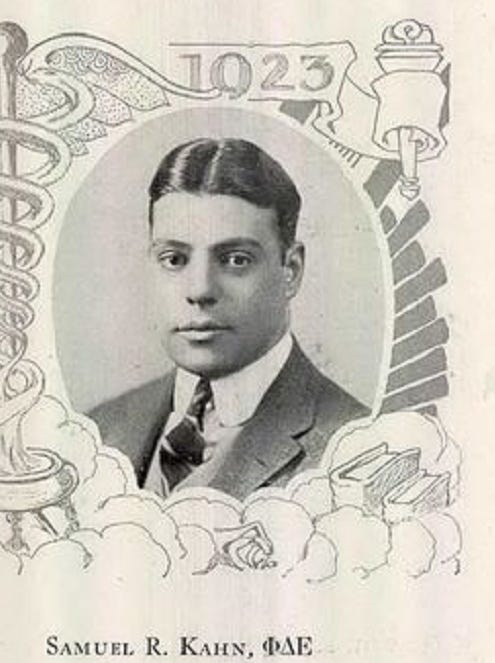
Dr. Samuel Robert Kahn completed the construction of 770 in 1936. I know he had deductions in building expenses. Or should I say זכות? Unbeknownst to Dr. Samuel Robert Kahn, he was building the בית חיינו. The doctor’s office was destined to be the throne of Messiah ממש, who will bring redemption to the long-suffering Jews and Gentiles. As the Holocaust and Gulag were about to sweep over Jews in Europe, the seed of our salvation was planted in Brooklyn. The doctor didn’t even have an opportunity to enjoy the remarkable structure. He is like the builder of Saint Basil’s Cathedral in Red Square, who gets blinded upon completion. Dr. Robert Kahn built the building, and it ruined his life. Tragically, he will not be the last to experience the curse of 770; many souls have perished there…
Here is the AI with minor editing (Grok):
Dr. S. Robert Kahn was a Jewish physician in Brooklyn, New York, during the 1930s. He commissioned and owned the building at 770 Eastern Parkway in Crown Heights, which he used as both a private residence and medical clinic. The structure, designed by architect Edwin Kline and completed around 1936, was built in a neighborhood popular with affluent, assimilated Jews at the time.
Dr. Kahn faced legal issues, including losing his medical license in 1937 for performing illegal abortions (abortion was largely prohibited in the U.S. at that time except in limited cases).
Due to these and financial troubles (including tax issues), the property was repossessed by the bank, allowing Chabad to acquire it in 1940.
F. Albert Hunt and Edwin Kline were New York-based architects who formed a partnership in the 1920s, specializing in high-end residential designs for affluent clients in suburban areas of New York State, particularly Long Island (Great Neck, Kings Point, Sands Point), Westchester County (Bronxville, Rye), and Pelham Manor. Their firm had offices on West 42nd St. They produced elegant homes primarily in historic revival styles, such as Tudor Revival, Colonial Revival, and eclectic blends popular during the Jazz Age for wealthy suburban estates. The duo’s work reflects the era’s preference for picturesque, historically inspired suburban architecture amid the booming North Shore of Long Island.
Edwin Kline (full name likely Edwin Hubbard Kline, 1889–1955) continued working independently after the partnership, notably designing the iconic Gothic Revival building at 770 Eastern Parkway in Brooklyn for Dr. S. Robert Kahn.
This happens frequently: a young, successful shvizer decides to build a royal palace with a clinic downstairs. The inexperienced builder overextends financially, cheats and steals everywhere to save the project, or, you might say, “his dream,” and it all comes tumbling down. Predictably, the architect Edwin Kline had to take Dr. Kahn to court to get paid1. Poor Dr. Kahn didn’t even have time to enjoy the building before he got ruined. But he killed a woman during an illegal abortion in 770, and he astonishingly got away with it.
Around 1938-1939, a Bronx woman had complications during an abortion in 770. She was transported to a local hospital, where she died. Dr. Kahn was arrested and charged with homicide (or manslaughter) but was ultimately acquitted of those charges. He had already lost his medical license in 1937, one year after 770 was built.
The abortion business was very lucrative, like bootlegging during the Prohibition. It wasn’t the running of the abortion mills, or even the death of the Bronx woman, that caused the downfall. Dr. Kahn was building an exquisite structure that required work from top-of-the-line vendors. The architect Edwin Kline put his soul and lifelong experience into the design of the landmark. Defaulting on vendor payments and creating enemies likely caused the collapse. You can't afford people who have a score with you when you are already vulnerable.
There were multiple crimes and trials: manslaughter, bribery, abortion, etc. Persecution finally focused on the method pioneered with Al Capone: go after taxes.
The doctor vacated his palace and the state-of-the-art abortion mill and spent several years (~2.5) in prison for tax crimes. A bank was left holding the difficult-to-flip mansion with an in-house clinic. After the prison, Mr. Kahn moved to Great Neck, Long Island. He kept aborting. He was arrested again in 1951 for practicing medicine without a license—specifically, performing high-priced abortions in his Great Neck home kitchen for $1,000 each ($12,500 today). Samuel Robert Kahn was again operating an abortion mill and was assisted by a 45-year-old woman, described in the records as his former wife.
Mr. Kahn died circa 1982 in Miami, Florida. It’s an all-around grim story.
The Windows
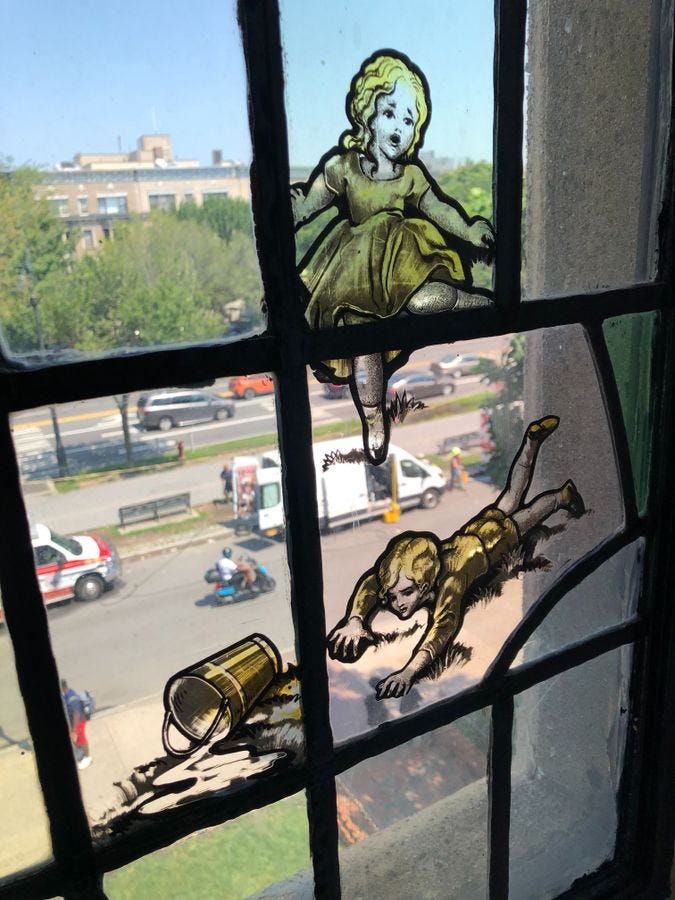
This is a painted (or enameled) stained glass window, a traditional type of decorative art glass found in churches, historical buildings, or institutions. This involves applying vitreous paint, made of powdered glass and metal oxides, onto the surface of a larger piece of glass. The piece is then fired in a kiln at a temperature high enough to melt the applied powder and fuse it permanently to the base glass. This allows for fine details and multiple colors. The glass is then precut, and the leaded mullions are installed. This makes a single pane of glass stronger, and the irregular shape of the smaller pieces makes the window more complex and visually appealing.
The picture depicts the classic English nursery rhyme. Is this window inside a “Jack and Jill” bathroom? Is there a “Jack and Jill” bathroom in 770?
Jack and Jill went up the hill
To fetch a pail of water;
Jack fell down and broke his crown
And Jill came tumbling after.
Since the market for this type of glass painting technique was churches, you can see that the artist was adept at drawing angelic, androgynous faces. I mean, look at Jack, whose only sign of being a boy is the shorts. And then there is a bucket/“pail of water” marked with a decorative cross; the artist was thinking no one would notice; he was right, until today.
There are multiple examples of the exquisite and playful enameled stained glass in 770. It all fell to the barbarian peasants who lived in the wood huts with straw roofs back in the tiny provincial village of Lubavitchi.
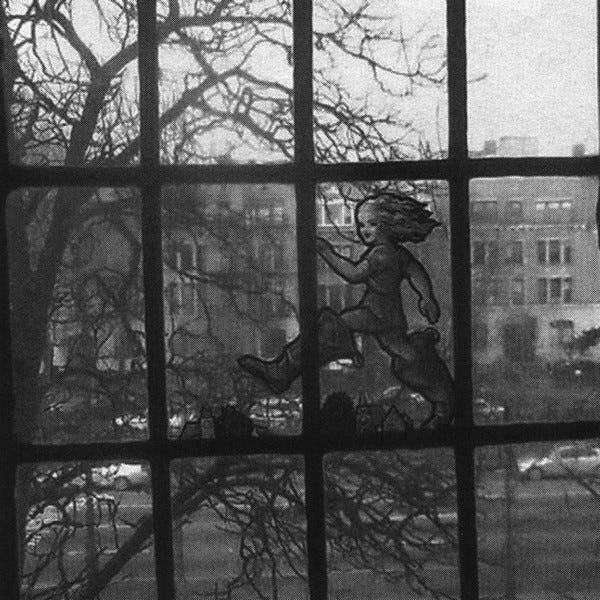
The radiant, haunting ghosts of the unborn…
Here goes the neighborhood
The building was perfect for the Rayatz: the clinic and waiting room became גן עדן התחתון and a synagogue. The doctor’s office is גן עדן העליו, for some, literally… Rayatz himself needed a clinic then, and the building already had an elevator. The windows of the “clinic” and the “doctors’ office,” the first-floor windows, are appropriately opaque with the stained glass.
At least Chabad wasn’t responsible for the design, or it would be hideous and ugly, like everything the peasants do. So when they recreate the 770 as a shrine in Kfar Chabad or elsewhere, do we have to assume that the “bad feng shui” is expunged? Not sure. You can still see white ceramic tile fitting the operating “procedure” room in a medical office. You can see the tile on the walls under the shelving and drywall. In the small room on the side of the Beis Hamedrash across from the Dovid Raskin memorial office/coat closet. When in this space, try not to meditate about history. It’s a disturbing memory.
Fools, you can’t match the craftsmanship; all you can do is roughly recreate the outline proportions of the three-gabled “Gothic Revival” building (modeled on the symmetrical front elevations of the Gothic cathedrals). I'm certain the architect Edwin Kline would be repulsed by the stealing of his masterful design and butchering it so thoroughly. It’s bad enough that Edwin Kline wasn’t fully paid for the original project, and now the barbarian vandals are inside the gates and looting. You can’t even match the brick baked with the distinct irregular protrusions on the face of the masonry or the complex crimson color or the exquisite precast molds around doors and windows. You can't match those decorative stone fleurons2. Craftsmen required for such a majestic mission have disappeared, like secular Jews and Gentiles with good taste, who built the regal houses on President St., Eastern Parkway, etc., vanished from Crown Heights, Brooklyn.
Update: Postmortem on the Builder of 770.
I originally wrote this post about something Barry Gourary alluded to in this interview here: “Hadashot” from Barry Gourary. But I don’t have the heart to say it.
A fleuron is a decorative ornament shaped like a flower or floral motif. It is commonly used as a terminal element to crown or accentuate vertical features such as gables or ridges.
A lurker is the lowest form of a human being.